
Vascular Malformations of Head, Face & Neck
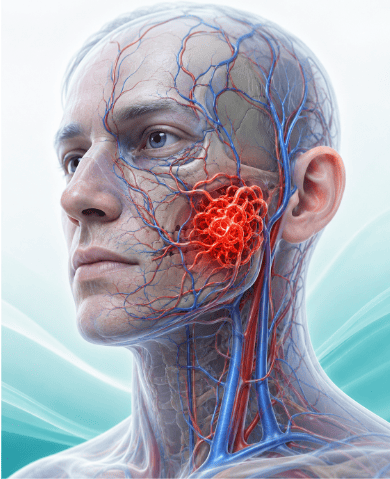
Vascular malformations of the head, face, and neck are abnormal blood vessel formations that may be present from birth and become more visible with age, growth, puberty, pregnancy, or increased blood flow. They can appear as a swelling, bluish skin discoloration, facial asymmetry, bleeding, pain, or difficulty with breathing, swallowing, speaking, vision, or mouth movement.
Unlike hemangiomas, which often shrink with time, true vascular malformations usually do not disappear on their own and may need planned treatment. Today, advanced imaging such as MRI, CT angiography, Doppler ultrasound, and digital subtraction angiography helps doctors understand the exact type, size, flow pattern, and risk level of the lesion.
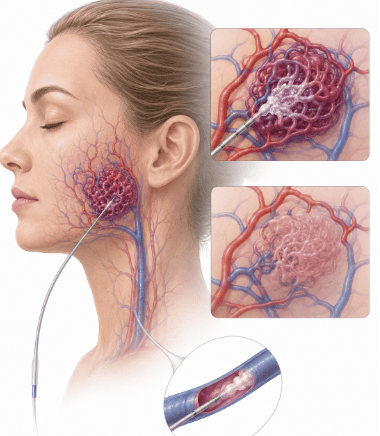
Treatment may include image-guided sclerotherapy, endovascular embolization, laser therapy, surgery, or combined staged treatment. Complex cases are best managed by a multidisciplinary team for safer functional and cosmetic outcomes.

Treatment includes:
Treatment depends on whether the malformation is low-flow or high-flow.
Low-flow venous or lymphatic malformations are often treated with image-guided sclerotherapy, where a medicine is injected into the abnormal vessels to shrink or close them. High-flow arteriovenous malformations may require endovascular embolization, where a microcatheter is guided into the abnormal vessel and special materials are used to block unsafe blood flow. In selected cases, embolization is done before surgery to reduce bleeding risk.
FAQs
Usually no. True vascular malformations tend to persist and may grow over time.
Not always. Treatment is advised when there is pain, bleeding, swelling, deformity, or functional difficulty.
No. It is a minimally invasive, image-guided treatment done through a needle.