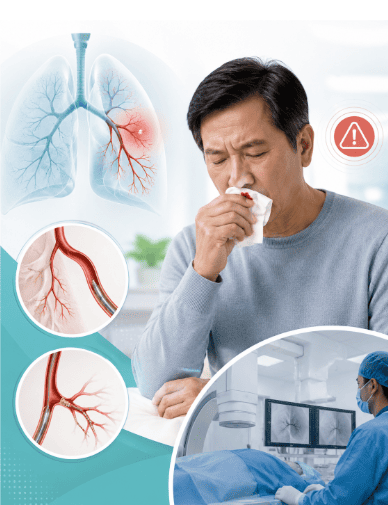
Bronchial Artery Embolization, or BAE, is an advanced minimally invasive treatment used to control severe or repeated coughing of blood, known as hemoptysis. In most life-threatening hemoptysis cases, bleeding comes from enlarged or abnormal bronchial arteries. BAE helps stop this bleeding without major open surgery. Modern CT angiography and digital subtraction angiography help identify the bleeding vessel with high precision before treatment. During the procedure, a thin catheter is usually inserted through the groin or wrist and guided to the abnormal bronchial artery. Tiny embolic particles, coils, or medical glue may then be used to block the bleeding vessel while preserving healthy lung circulation. BAE is commonly used for bleeding related to tuberculosis, bronchiectasis, lung infection, tumors, or abnormal vessels. It provides rapid bleeding control and can be repeated if required, while the underlying lung disease is treated separately.
Treatment includes:
CT angiography to locate the bleeding source, catheter-based angiography for vessel mapping, selective bronchial artery to embolization and using particles/coils/glue, ICU support when needed, and medical treatment for the root cause such as TB, infection, bronchiectasis, or tumor.
FAQs
Is Bronchial Artery Embolization open surgery?
No. It is a minimally invasive image-guided procedure done through a small catheter.
When is BAE needed?
It is used when coughing blood is severe, recurrent, or life-threatening.
Can bleeding come back after BAE?
Yes, recurrence can happen if the underlying disease remains active, but repeat embolization may help.
Is BAE safe?
BAE is widely used and effective, but like any procedure, it requires expert planning to reduce risks.