
Vertebroplasty Treatment
Vertebroplasty is a minimally invasive spine procedure used to treat painful vertebral compression fractures. These fractures often happen when the bones of the spine become weak due to osteoporosis, injury, or certain spinal tumors.
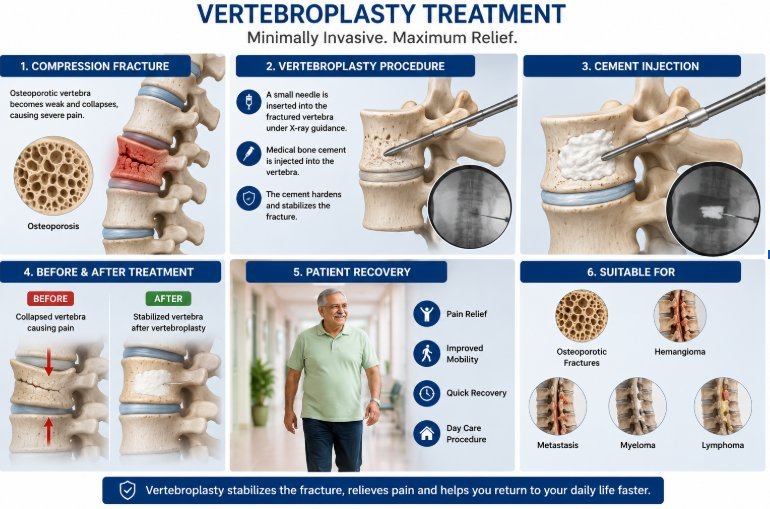
In this procedure, medical-grade bone cement is carefully injected into the collapsed or fractured vertebra to help stabilize the bone and reduce pain. Mayo Clinic explains that vertebroplasty is commonly used to relieve pain caused by compression fractures, especially when osteoporosis or cancer weakens the spinal bones.
When is Vertebroplasty Needed?
Vertebroplasty may be considered for patients who have:
- Severe back pain due to spinal compression fracture
- Osteoporosis-related vertebral collapse
- Pain that does not improve with medicines, rest, or bracing
- Difficulty walking, standing, or doing daily activities
- Vertebral weakness due to tumors such as hemangioma, metastasis, lymphoma, myeloma, or other spinal lesions
Cleveland Clinic also notes that vertebroplasty is a minimally invasive procedure for compression fractures and is often done as an outpatient or same-day procedure.
Treatment Options for Vertebral Compression Fractures
1. Conservative Treatment
For mild compression fractures, treatment may start with non-surgical care.
- Pain-relief medicines
- Short period of rest
- Spine brace support
- Calcium and Vitamin D supplements
- Osteoporosis medicines
- Physiotherapy after pain improves
- Lifestyle changes to improve bone strength
This may help some patients, but severe pain or progressive collapse may need advanced treatment.
2. Vertebroplasty
Vertebroplasty is a minimally invasive treatment where medical bone cement is injected into the fractured vertebra.
How it helps:
- Stabilizes the collapsed spinal bone
- Reduces severe back pain
- Helps patients move better
- May reduce dependency on pain medicines
- Can be done as a day-care procedure in selected patients
Procedure:
- A fine needle is guided into the fractured vertebra
- Real-time X-ray/fluoroscopy guidance is used
- Bone cement is injected into the vertebra
- The cement hardens and stabilizes the fracture
3. Kyphoplasty
Kyphoplasty is similar to vertebroplasty, but a small balloon may be used before cement injection.
How it helps:
- Creates space inside the collapsed vertebra
- May help restore some vertebral height
- Stabilizes the fracture with bone cement
- Helps reduce pain and improve mobility
4. Vertebroplasty for Spinal Tumors
Vertebroplasty may also be used when vertebrae become weak due to tumors.
It may help in selected cases of:
- Hemangioma
- Metastasis
- Myeloma
- Lymphoma
- Tumor-related vertebral collapse
The aim is to stabilize the affected vertebra and reduce pain.
Benefits of Vertebroplasty Treatment
- Minimally invasive procedure
- No major open surgery
- Faster recovery
- Significant pain relief in many patients
- Improved daily movement
- Short hospital stay
- Helps stabilize weak spinal bones
For persistent back pain due to spinal compression fracture, osteoporosis, or tumor-related vertebral weakness, consult Dr. Sukalyan Purkayastha for advanced spine evaluation and minimally invasive vertebroplasty treatment in Kolkata.
FAQs
No. Vertebroplasty is a minimally invasive procedure done through a small needle puncture, not a large surgical incision.
The procedure is usually done under local anesthesia with medicines for comfort, so most patients tolerate it well.
Patients with painful vertebral compression fractures that do not improve with conservative treatment may be considered after proper imaging and specialist evaluation.
Yes. It is commonly used for selected painful compression fractures caused by osteoporosis.
Yes. In selected cases, it may help stabilize vertebrae weakened by tumors such as metastasis, myeloma, lymphoma, or hemangioma.